
The FIFA World Cup is the most watched sporting event in the world, followed by billions of fans across continents. With such a long and dramatic history, it’s no surprise that many world cup myths have emerged over time. Some of these stories sound believable, others are repeated so often that fans accept them as facts. However, when we look closely at history, many popular world cup myths simply aren’t true. In this article, we break down some of the most common FIFA world cup myths and explain what actually happened.
Myths About Early Tournaments
One of the most common world cup myths is that the tournament was perfectly organized from the very beginning. In reality, early World Cups were chaotic, experimental, and sometimes poorly managed.
The first World Cup in 1930 had no qualification process, limited international travel, and uneven officiating. Matches were played without substitutions, referees sometimes reversed decisions, and teams often faced confusing rules. These early issues show that the idea of a flawless World Cup from day one is one of the oldest world cup myths.
World Cup Myths About the Trophy

Another popular world cup myth is that the current FIFA World Cup trophy has always been awarded to winners. This is completely false.
The original trophy was called the Jules Rimet Trophy and was used from 1930 to 1970. After Brazil won the tournament for the third time in 1970, they were allowed to keep it permanently. That same trophy was later stolen in 1983 and never recovered. The current trophy was introduced in 1974 and is never permanently given to winning teams, proving yet another widely believed world cup myth wrong.
World Cup Myths About Hosting the Tournament
Many fans believe that hosting the World Cup almost guarantees success. This is one of the most misleading world cup myths.
While some host nations have won the tournament, the majority have not. In fact, most World Cups have been won by teams playing outside their home country. Hosting brings advantages such as fan support, but it also brings pressure, expectations, and distractions. The belief that host nations are destined to win remains one of the most repeated world cup myths.
World Cup Myths About India and the 1950 World Cup
One of the most persistent world cup myths is that India was banned from the 1950 World Cup for playing barefoot. The truth is more complicated.
India qualified for the 1950 tournament but withdrew voluntarily. Financial difficulties, travel challenges, and preparation issues were the main reasons. While footwear regulations were a factor, India was not officially banned. Over time, this story was simplified into a dramatic myth, becoming one of the most misunderstood world cup myths in football history.
Myths About Records and Fastest Goals
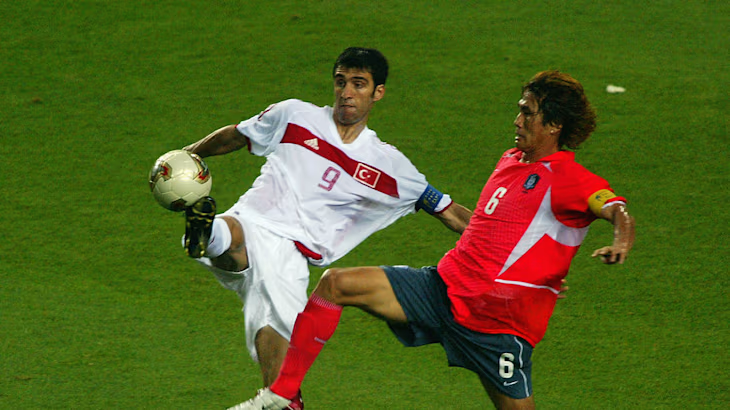
Fans love records, but they are also the source of many world cup myths. One example is the belief that the fastest World Cup goal was scored in just a few seconds.
The actual fastest goal in World Cup history was scored by Turkey’s Hakan Şükür in 2002 at 10.8 seconds. While still remarkable, it’s often exaggerated in conversations. This exaggeration shows how easily facts turn into world cup myths when retold repeatedly.
Myths About Star Players
Another major category of world cup myths revolves around superstar players. Many people believe that the best players always win the World Cup.
History proves otherwise. Several legendary footballers never lifted the trophy despite extraordinary careers. Winning the World Cup depends on team balance, tactics, preparation, and timing not individual talent alone. The belief that greatness guarantees a World Cup title remains one of the most common world cup myths.
World Cup Myths About Organization and Discipline
Modern fans often assume that World Cup matches have always followed strict rules and perfect officiating. This assumption fuels many world cup myths.
In earlier tournaments, players were sent off for strange reasons, referees made major mistakes, and disciplinary rules were inconsistent. In one famous match, a referee even issued three yellow cards to the same player before finally sending him off. These moments highlight how the idea of perfect discipline is one of the more amusing world cup myths.
World Cup Myths About Small Nations

A widely believed FIFA world cup myth is that only large footballing nations matter. Smaller countries are often overlooked, yet they have created some of the tournament’s most memorable moments.
From underdog teams shocking giants to unlikely qualifiers making history, the World Cup has always been about more than just powerhouses. The belief that small nations don’t belong on the world stage is another world cup myth that history has repeatedly disproven.
Why World Cup Myths Continue to Exist
The reason FIFA world cup myths survive is simple: storytelling. Fans love dramatic narratives, and social media spreads misinformation faster than facts. Over decades, real events become exaggerated, simplified, or misremembered.
Without revisiting historical records, many world cup myths continue to be accepted as truth.
Conclusion
The FIFA World Cup is filled with unforgettable moments, but it is also surrounded by countless world cup myths. From trophy stories to player records and hosting misconceptions, many popular beliefs don’t hold up when examined closely.
Understanding the truth behind these world cup myths not only deepens our appreciation of football history but also reminds us that the real stories are often stranger and more fascinating than the myths themselves.